Las Vegas (AFP) – Technology causes us to lose sleep, but can it also give it back?
Companies aiming to help insomniacs, inveterate snorers and nap lovers showed off their latest gadgets at the Consumer Electronics Show in Las Vegas.
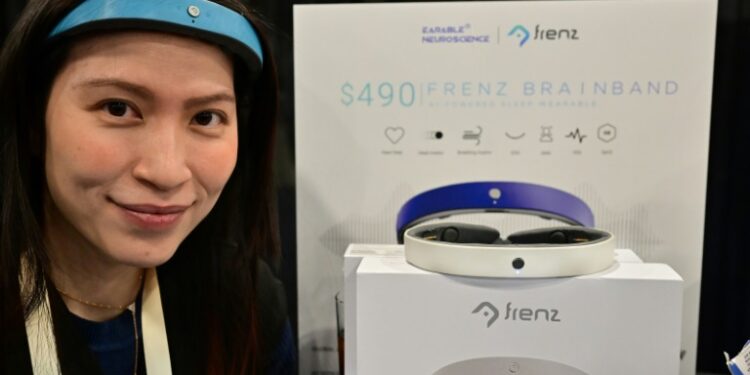
“We are the world’s first AI powered…sleep tracker and personal sleep stimulator that enhances deep sleep and also the time to fall asleep,” said Kimi Doan, Investment Manager at Earable neuroscience.
She presented the “Brainband,” recently launched for almost $500.
Designed as a cushioned crown, the band’s gold-plated sensors analyze brain activity in real time, and its speakers play music, meditation mantras or white noise, depending on the needs detected.
After you fall asleep, AI will know the content that helped induce the slumber and play that again if you wake up in the middle of the night, she said.
“Basically you won’t be disturbed during your sleep.”
Vital to our well-being, sleep has deteriorated due to health problems or the stress of modern life.
In the United States, according to the Sleep Foundation, nearly a third of adults sleep less than seven hours a night, the minimum recommended to avoid aggravating the risks of cardiovascular disease and obesity.
The foundation estimates that fatigue at work costs US companies around $136.4 billion dollars annually
.
– Pink Noise perfection – In 2024, Sleeping Beauty is likely scrolling through her smartphone before calling it a night, making a good sleep all the more difficult.
The tech answer: accessories to analyze your sleep and connected mattresses, which intervene to ease the road to dreamland, thanks to AI.
In April, Taiwan-based PranaQ will launch TipTraQ, a biometric sensor to be worn on the fingertip at night that interacts with a mobile app, for $200.
Users will be able to consult readouts on their sleep phases and interact with an AI chatbot, specially trained on scientific research.
The company hopes soon to obtain medical approval for its device in the monitoring of sleep apnea, often responsible for snoring, a disorder from which two of the co-founders suffer.
Jonathan Berent, founder of NextSense, also has medical ambitions for his earpieces, initially designed to detect and monitor epilepsy.
When they go on sale in a year’s time for $130, they will initially be used to analyze and improve sleep quality.
“When you play pink noise at a certain level, during a slow wave (or deep sleep) period of sleep you can actually increase the amplitude of the slow wave” prolonging the deep sleep
.
– AI mattress – “There is a sense that sort of by knowing metrics around our sleep, that we can gain some sort of control over it and for many people that can be true” said Wendy Troxel, senior behavior scientist at the Rand corporation.
“The reality about sleep is, the more you work for it, often, the more it will elude you,” she said, explaining that the sleep metrics “can actually be anxiety provoking.”
To relax, insomniacs can latch onto a $200 Moonbird.This connected anti-stress ball inflates and deflates, guiding breathing exercises conducive to falling asleep.
“I was super skeptical,” said Michael Broes, co-founder of the Belgian start-up, before explaining that these exercises enable you to synchronize your heart rate with your breathing rate, a key element in relaxation.
Another sleep-disturbing factor is bed temperature.
“We made a lot of market surveys and asked a lot of people around the world and the main issue with bad sleep is temperature,” said Daniela Kooijman of Variowell, a German company that has developed heating and cooling strips for mattresses.
Many manufacturers have invested in temperature control systems for different body zones on either side of the bed.
Like the Chinese company DeRucci, whose AI-inflated mattresses change shape according to the sleeper’s position and analyze his or her sleep.
Zhu Huan, with DeRucci’s smart sleep division, said the products are the result of a decade of research and development.
The price of the perfect bed: between $3,000 and $20,000, depending on the options.