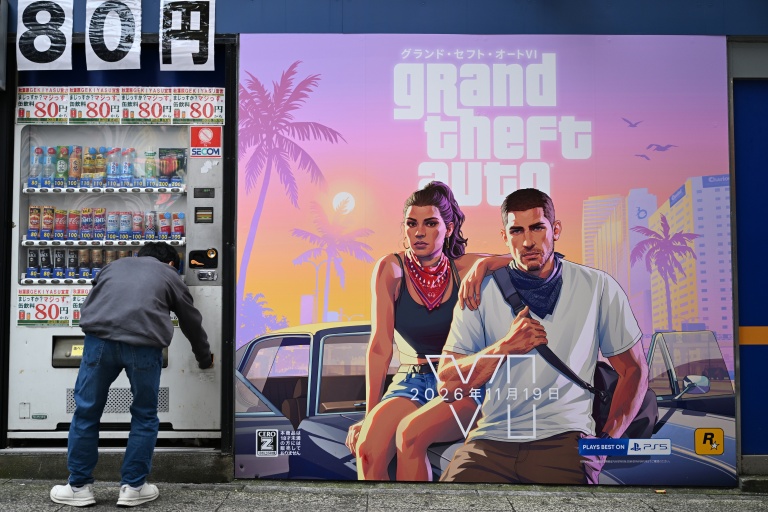
Paris (France) (AFP) – From 24-hour news channel parodies and extreme stereotypes to a twisted Statue of Liberty, the Grand Theft Auto series has consistently mocked the excesses of US capitalist society. But with days to go before the release of the hugely popular video game’s new installment, players and analysts are wondering if changes in studio Rockstar’s creative team suggest a possible shift into less controversial territory, and an end to the punk-rock transgressions that helped turn GTA into a cultural phenomenon.
In marketing and communications leading up to the release of the new “GTA VI” on November 19, Rockstar seems keener to steer the conversation toward its Bonnie-and-Clyde-style protagonists trying to survive in a fictionalized, crime-ravaged Miami. “It’s a valid question,” said expert Olivier Mauco, author of the book “GTA IV, the Dark Side of the American Dream”, noting the various presentations of the new game had so far put the franchise’s famed political incorrectness “much less front and centre”.
Looking for an explanation for the possible toning-down, Chris Klippel, founder of the specialist outlet Rockstar Mag, noted that “of the five writers who worked on GTA V, three have left,” including Dan Houser, one of the two brothers who founded the studio. “So that inevitably raises concerns.” For expert Christopher Dring, GTA’s “punk rock” style is part of Rockstar’s DNA. “That’s the whole idea behind them. They know they’re middle fingers to the establishment. They like making cultural moments. They like people talking about them. They won’t play it safe, and if they do, it will be disappointing.”
– Criticism and controversy –
GTA’s taste for transgression goes back to the very first installment, in 1997. “To get people talking about them and come across as the bad boys of the industry, the Houser brothers made it seem like GTA was encouraging kids to steal cars,” said Mauco. The bad-boy reputation stuck to the series, which has been regularly accused of glorifying violence and inciting criminal behavior, even as it became a symbol of rebellious culture. Starting with “Vice City” (2002) and “San Andreas” (2004), Rockstar gradually began weaving social issues into its gangster stories.
The turning point came with “GTA IV,” released in 2008, which features a protagonist — an immigrant from Eastern Europe — trapped in a spiral of violence as he confronts the flip side of the American dream. “It’s certainly the most thoroughly written in terms of social critique,” said Mauco. “It’s practically an auteur game, which is pretty wild and paradoxical because even back then it was already one of the most expensive games ever developed.”
– Walking a tightrope –
Released in 2013, the next installment, “GTA V,” involves a microcosm of US class warfare with stereotypes on both sides: left-leaning urbane hipsters pitted against Midwestern rednecks. For Mauco, it portrayed “an America that no longer talks to itself,” three years before Donald Trump won the White House. Although the game has since sold more than 230 million copies, it is difficult to gauge how much gamers cared about its political message. A lot of GTA’s players “are mostly there to blow off steam” and unleash chaos in these vast fictional metropolises, said Klippel.
“I still think it’s going to remain very satirical — that’s the whole appeal of the series,” said Dring, an expert for the specialist outlet The Game Business. Dring compared GTA’s biting humor to that of the cartoon “South Park,” and warned against expecting direct attacks on Trump or Russia in “GTA VI.” He predicted instead “a critical look at culture and society,” starting with the omnipresence of social media. “GTA has always managed to find the right balance: a world that invites escapism while poking fun at the problems of the modern world.” A thorny tightrope to walk if the game wants to avoid being accused of having a political agenda — a major no-no for many of its biggest fans.
© 2024 AFP