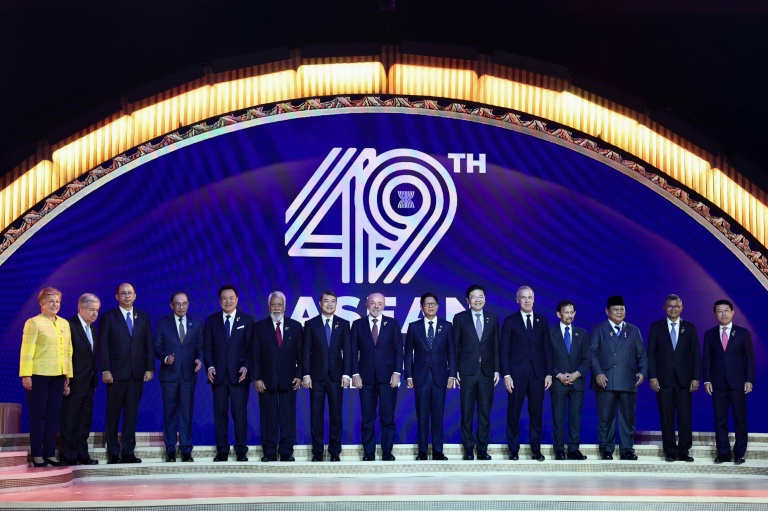
Manila (AFP) – A key summit opened Sunday in Manila, with Southeast Asian heads of state grappling with the Middle East crisis and their own regional flashpoints, while global leaders found common ground over US President Donald Trump’s trade war. Trump is scheduled to arrive Tuesday, near the summit’s conclusion, for a visit that will include a meeting with the leaders of his fellow Quad countries India, Japan, and Australia — the first such sit-down of his second term.
However, it was the US leader’s tariff blizzard that Brazil’s newly re-elected President Luiz Inacio Lula da Silva had in mind Sunday in Manila. “Brazil has learned an extraordinary lesson after the US decided to impose tariffs (on other countries),” he told reporters on the sidelines of the 11-member Association of Southeast Asian Nations (ASEAN) summit. “Instead of weeping or begging the US government … to have pity on us, we decided to look for other partners for us to sell and for us to buy from,” he stated, noting that trade with regional states Indonesia and Vietnam had jumped by 15 and 13 percent, respectively.
Canadian Prime Minister Mark Carney echoed this sentiment at the summit a day earlier, while promoting a new Philippine free-trade deal and ASEAN trade talks that he said had been “substantially concluded.” He described the two pacts as part of a strategy to develop a dense web of reliable partners to create more opportunities and reduce relative reliance on the United States.
Lula mentioned that he had met with Carney on the summit’s sidelines, inviting him to make an official visit to Brazil and expressing hopes to double trade with Canada. Meanwhile, nearly 20,000 police officers have been deployed around Metro Manila for the summit, as progressive groups anticipate thousands of attendees for an anti-Trump march on the summit site on Tuesday. Much of the uproar targets the US Pax Silica program — a supply-chain initiative designed to counter China’s dominance in semiconductors and rare earths — whose flagship Philippine project, a 1,620-hectare AI manufacturing hub north of Manila, threatens to displace Indigenous families.
On Sunday, a crowd of about 200 protesters, some carrying signs reading “the Philippines is not for sale” and “Ban Trump!” clashed with police who blocked an attempted march. AFP reporters witnessed at least three demonstrators taken away by officers.
Two issues that have vexed ASEAN leaders for years — a languishing South China Sea “Code of Conduct” and the relationship with war-torn Myanmar — will become Singapore’s challenge when the bloc’s rotating chair passes to the city-state in 2027. Myanmar has been excluded from high-level ASEAN meetings since a 2021 military coup ousted the elected government of Aung San Suu Kyi, triggering an ongoing civil war. Thailand, which shares a border with Myanmar and is advocating for closer relations, last week called for Naypyidaw’s foreign minister to be readmitted to meetings.
On Sunday, a joint ASEAN statement called for “calibrated engagement” with the Myanmar government, reflecting language Thailand has used for months. However, normalization would depend on “concrete progress” regarding a five-point peace plan, according to the statement. Philippine President Ferdinand Marcos has previously conceded that the plan has made no progress.
Hopes of achieving a so-called Code of Conduct in the disputed South China Sea between ASEAN states and China during Manila’s year in the chair have come to an end. Philippine Foreign Secretary Theresa Lazaro, who had previously stated that negotiations were “80 percent complete,” informed reporters on Sunday that she trusted “that Singapore will be able to finish the discussions” next year. Beijing claims most of the South China Sea, despite an international ruling that its assertion has no legal basis, and its coast guard has clashed repeatedly with that of the Philippines. The dispute has resurfaced at inopportune moments during the Philippines’ tenure as chair of ASEAN, including a July foreign ministers summit that opened less than a day after a clash between Chinese and Philippine sailors.
ASEAN is scheduled to meet with Chinese Prime Minister Li Qiang on Monday.
© 2024 AFP