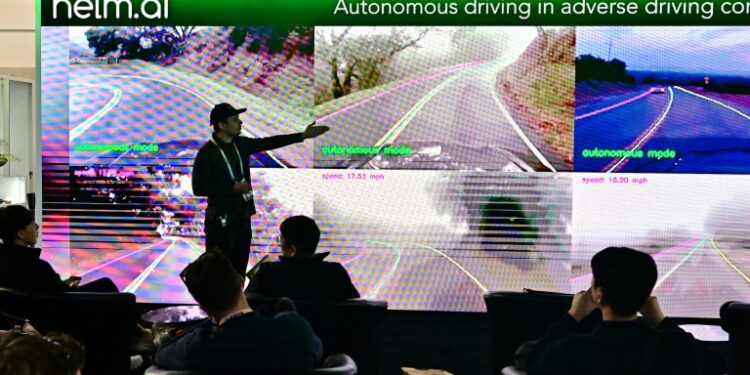
Las Vegas (AFP) – To the believers, the oft-promised autonomous car revolution is “clearly happening” — they point to the myriad displays at the Consumers Electronics Show in Las Vegas that defy the industry’s bad headlines.
“Companies are deploying robotaxis in larger scale than before and in more cities,” insisted Kersten Heineke, partner and codirector of the McKinsey Center for Future Mobility.
Even “in times where money is scarce…we’re clearly progressing.It just takes a bit longer than we were expecting three or five years ago.”
And while “there’s nothing flashy” at this year’s CES, there are noted improvements “in crucial technologies” on show, he said.
Still the headwinds — and doubts — are there, with venture capital harder to secure and a series of mishaps grabbing attention, even if some data demonstrates that fears are not merited
.
– Cameras, lasers and 3D – The focus now is on safety.
From long-established companies to young start-ups, the aisles at CES are brimming with innovations in 3D vision, night vision, driver fatigue detectors and hand-on-wheel detection.
“Technology saves lives” by improving road safety, said Christophe Perillat, head of the French Valeo group.
He believes that by 2030, 90 percent of vehicles produced worldwide will be equipped with driver assistance systems, and half of those will be level 2 and 2+, with a few million at level 3 or 4.
This refers to the industry standard set by the trade association SAE International that gauges a vehicle’s degree of automation, from level 0 to level 5.
The latter level, considered the equivalent of a human driver, seems out of reach at this stage.
“The ability for a consumer to buy a car that will drive itself everywhere without the driver ready to take the wheel is unlikely to happen by 2035,” predicted S&P Global Mobility in a recent study.
But “the array of automated driver assist systems to compensate for driver inattention or error will proliferate,” helping reduce crashes, injuries and deaths along the way.
Artificial intelligence is also spreading in this sector.
“If you can sense alertness based upon facial features, the attention of the eye …you can do things to influence the …safety of a driver,” said Adam Burden of Accenture
.
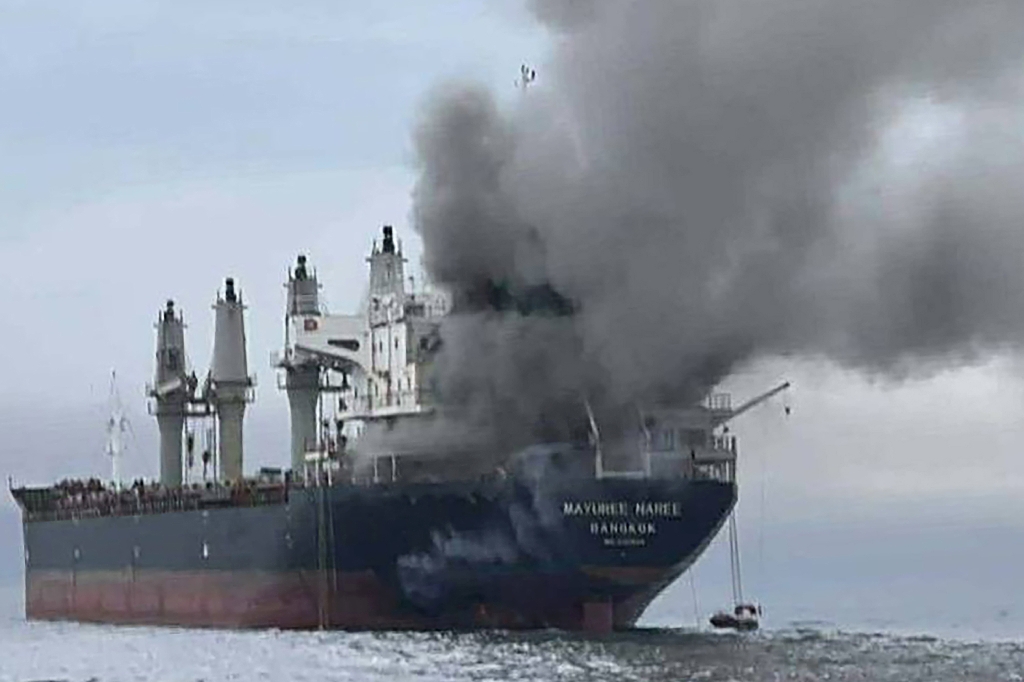
– Not so ‘Autopilot’ – But, for the time being, autonomous vehicles mainly make headlines when they are involved in accidents.
Cruise, a subsidiary of General Motors, suspended its activities indefinitely at the end of October after several accidents and the suspension of its permits in California.
The company had been operating its robotaxis in several US cities.
Tesla’s “Autopilot” assisted driving system (which is level 2) was accused of giving drivers the false impression that the car was driving itself, thereby provoking accidents.
The Washington Post claimed in June, after scrutinizing data from the US National Highway Traffic Safety Administration (NHTSA), that “Autopilot” mode had been involved in 736 accidents and seventeen deaths in the US since 2019.
According to a recent study by reinsurer Swiss Re, basing itself on Google’s Waymo One driverless taxis, the autonomous vehicle is “is significantly safer towards other road users than human drivers are.”
For now, the sector is splitting in two directions: professional users, with fleets of robotaxis and shuttles, and private users, with less automation.
This is driven by safety and regulatory reasons, but also because of price, as a Level 4 vehicles will cost $10,000 more.
But for fleets that can operate over 24 hours every day of the year, this extra cost is quickly recouped.
Heineke from McKinsey expects “hundreds of thousands of robotaxis” to be on the road within the next three to five years, with China leading the way.
According to the McKinsey Center for Future Mobility, autonomous driving could generate between $300 and $400 billion worldwide by 2035.