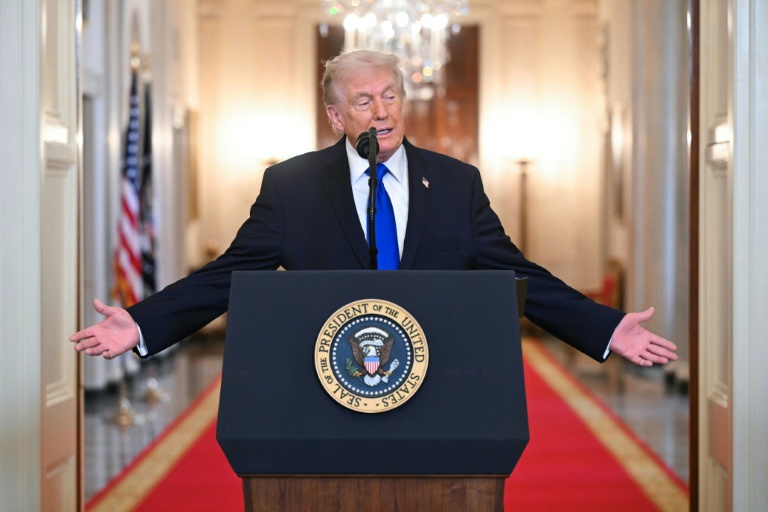
(AFP) – US President Donald Trump’s push to reimpose tariffs after his Supreme Court setback has raised questions about his trade deals and future plans, while fueling a rush for refunds. Here is the state of play as Trump moves to rebuild his trade agenda:
– **Where do his tariffs stand?**
Trump’s new 10-percent tariff on imports took effect Tuesday and will last for 150 days. It is widely viewed as a bridge towards more lasting action. This does not apply to sectors targeted by separate investigations such as steel, aluminum, and autos, nor does it hit the swath of goods entering the United States under the US-Mexico-Canada Agreement. Trump has pledged to raise this tariff to 15 percent. But US trade envoy Jamieson Greer maintained Wednesday on Fox Business that Washington seeks continuity in its trade policy. “We have the 10-percent tariff. It’ll go up to 15 for some, and then it may go higher for others,” he said. “I think it will be in line with the types of tariffs we’ve been seeing.” A uniform tariff hike to 15 percent will strike partners like Britain, who faced a lower level previously.
– **Why are countries not retaliating?**
US trading partners who have struck deals with Washington have so far been seeking clarity but avoided clashes over the new tariffs. “A lot of the issue is the sector-specific exemptions that they got,” said former US trade official Ryan Majerus, now a partner at King & Spalding. The European Union, Japan, and South Korea all struck deals that lowered US tariffs on their car exports, from 25 percent to 15 percent. As sectoral tariffs were not affected by the high court ruling, Majerus told AFP that countries would be wary of giving up their gains. If they violate their trade pacts, Washington could also further penalize them under well-established laws.
– **What are Trump’s plans?**
The Trump administration has signaled plans to reimpose more lasting tariffs — citing national security concerns or unfair trading practices as a justification. These are areas where Washington can have “very durable tariffs where necessary,” Greer told Fox Business. “They’ve stood up to legal scrutiny in the past, and they will again.” Trump’s existing sector-specific tariffs, for example, were imposed under Section 232 of the Trade Expansion Act, which allows the president to roll out levies over national security risks. Another authority, Section 301 of the Trade Act, allows Washington to address unfair foreign trade practices. It was Trump’s main instrument to target China in his first presidency. Trump’s future tariffs could cover industries like large-scale batteries, cast iron and iron fittings, plastic piping, industrial chemicals, and power grid and telecom equipment, The Wall Street Journal reported. These would be issued under Section 232. Besides these, trade lawyer Dave Townsend of Dorsey & Whitney expects to see “exceedingly broad” investigations under Section 301 that would allow Trump “to impose tariffs on many, if not most, countries.” “By the end of the year, we would be back pretty close to where we were last week,” he said.
– **Who gets refunds?**
Separately, US importers are battling for tariff refunds, an issue the Supreme Court ruling did not cover. Greer maintained that “those claims are proceeding,” adding that lower courts will deal with that. “They’ll tell us the time, place, and manner of any type of refund,” he said. But there could be further complications. “Firms are unlikely to pass on the benefit of these refunds to consumers,” said Bernard Yaros of Oxford Economics. “Most of the tariff cost has already fed through to core consumer goods prices.” The mechanics and timing of returns are also unclear. The refunds process to importers may not be messy. But purchasers of goods, if they are not importers themselves, could have to litigate further to get their money back, Townsend told AFP.
– Beiyi SEOW
© 2024 AFP