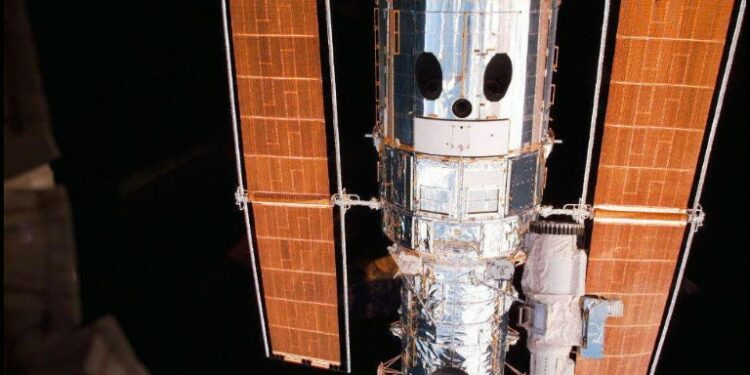
Washington (AFP) – The Hubble Space Telescope has observed the smallest planet outside our solar system to contain water vapor in its atmosphere, a “landmark discovery” that brings astronomy a step closer to characterizing Earth-like worlds.
At around twice Earth’s diameter, planet GJ 9827d orbits a red dwarf star 97 light-years away in the constellation Pisces, NASA and the European Space Agency (ESA) said in statements on Thursday.
The team behind the finding are examining two scenarios: either the planet is a “mini-Neptune” with a hydrogen-rich atmosphere laced with water, or it’s a warmer version of Jupiter’s moon Europa, which contains twice as much water as Earth under its crust.
“The planet GJ 9827d could be half water, half rock,” said Bjorn Benneke of the Universite de Montreal, who co-led the research.
“And there would be a lot of water vapor on top of some smaller rocky body.”
“Until now, we had not been able to directly detect the atmosphere of such a small planet.And we’re slowly getting in this regime now,” he added.
Over a period of three years, Hubble observed the planet during 11 transients, or events in which it crossed in front of its star.
During transients, starlight is filtered through the planet’s atmosphere, allowing astronomers to use Hubble’s instruments to analyze the patterns of colors (wavelengths), which revealed the telltale signature of water molecules.
Even if GJ 9827d has a water-rich atmosphere, its hot, Venus-like temperature of 800 degrees Fahrenheit (425 Celsius) would make it an uninhabitable steamy world.
Nevertheless, the Hubble discovery paves the way to future study of GJ 9827d and similar planets, especially by the James Webb Space Telescope, which can use its high resolution infrared images to look for more atmospheric molecules including carbon dioxide, and methane.
“Water on a planet this small is a landmark discovery,” added co-leader Laura Kreidberg of Max Planck Institute for Astronomy in Germany.
“It pushes closer than ever to characterizing truly Earth-like worlds.”