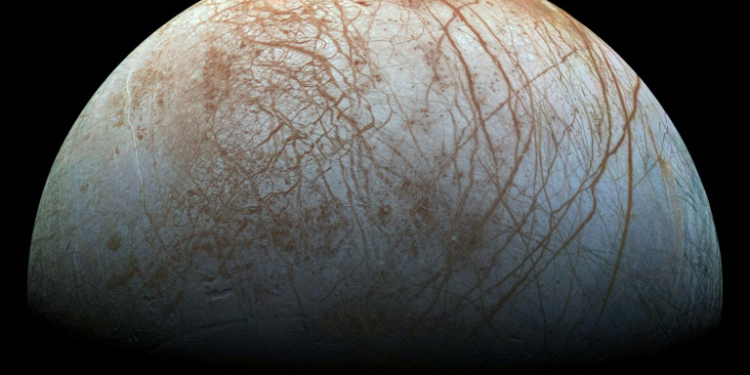
Cape Canaveral (AFP) – Is there anywhere else in our solar system that could support life? An imposing NASA probe is due to lift off on Monday on a five-and-a-half-year journey to Europa, one of Jupiter’s many moons, to take the first detailed step toward finding out. The Europa Clipper mission will allow the US space agency to uncover new details about the moon, which scientists believe could hold an ocean of liquid water beneath its icy surface.
Liftoff is scheduled for “no earlier than” Monday, October 14, from Cape Canaveral in Florida aboard a powerful SpaceX Falcon Heavy rocket, NASA said in a statement. “Europa is one of the most promising places to look for life beyond Earth,” said NASA official Gina DiBraccio at a news conference last month. The mission will not look directly for signs of life but will instead look to answer the question: Does Europa contain the ingredients that would allow life to be present? If it does, another mission would then have to make the journey to try and detect it.
“It’s a chance for us to explore not a world that might have been habitable billions of years ago,” like Mars, Europa Clipper program scientist Curt Niebur told reporters last month, “but a world that might be habitable today, right now.” The probe is the largest ever designed by NASA for interplanetary exploration. It is 30 meters wide when its immense solar panels — designed to capture the weak light that reaches Jupiter — are fully extended.
While Europa’s existence has been known since 1610, the first close-up images were taken by the Voyager probes in 1979, which revealed mysterious reddish lines crisscrossing its surface. The next probe to reach Jupiter’s icy moon was NASA’s Galileo probe in the 1990s, which found it was highly likely that the moon was home to an ocean. This time, the Europa Clipper probe will carry a host of sophisticated instruments, including cameras, a spectrograph, radar, and a magnetometer to measure its magnetic forces.
The mission will look to determine the structure and composition of Europa’s icy surface, its depth, and even the salinity of its ocean, as well as the way the two interact — to find out, for example, if water rises to the surface in places. The aim is to understand whether the three ingredients necessary for life are present: water, energy, and certain chemical compounds. If these conditions exist on Europa, life could be found in the ocean in the form of primitive bacteria, explained Bonnie Buratti, the mission’s deputy project scientist. However, the bacteria would likely be too deep for the Europa Clipper to see.
And what if Europa isn’t habitable after all? “That also opens up a whole wealth of questions: Why did we think this? And why is it not there?” said Nikki Fox, an associate administrator at NASA.
The probe will cover 2.9 billion kilometers (1.8 billion miles) during its journey to Jupiter, with arrival expected in April 2030. The main mission will last another four years. The probe will make 49 close flybys over Europa, coming as close as 25 kilometers (16 miles) above the surface. It will be subjected to intense radiation — the equivalent of several million chest x-rays on each pass.
Some 4,000 people have been working on the $5.2 billion mission for around a decade. NASA says the investment is justified by the importance of the data that will be collected. If our solar system turns out to be home to two habitable worlds (Europa and Earth), “think of what that means when you extend that result to the billions and billions of other solar systems in this galaxy,” said Niebur, the Europa Clipper program scientist.
“Setting aside the ‘Is there life?’ question on Europa, just the habitability question in and of itself opens up a huge new paradigm for searching for life in the galaxy,” he added. The Europa Clipper will operate at the same time as the European Space Agency’s (ESA) Juice probe, which will study two other moons of Jupiter — Ganymede and Callisto.
© 2024 AFP