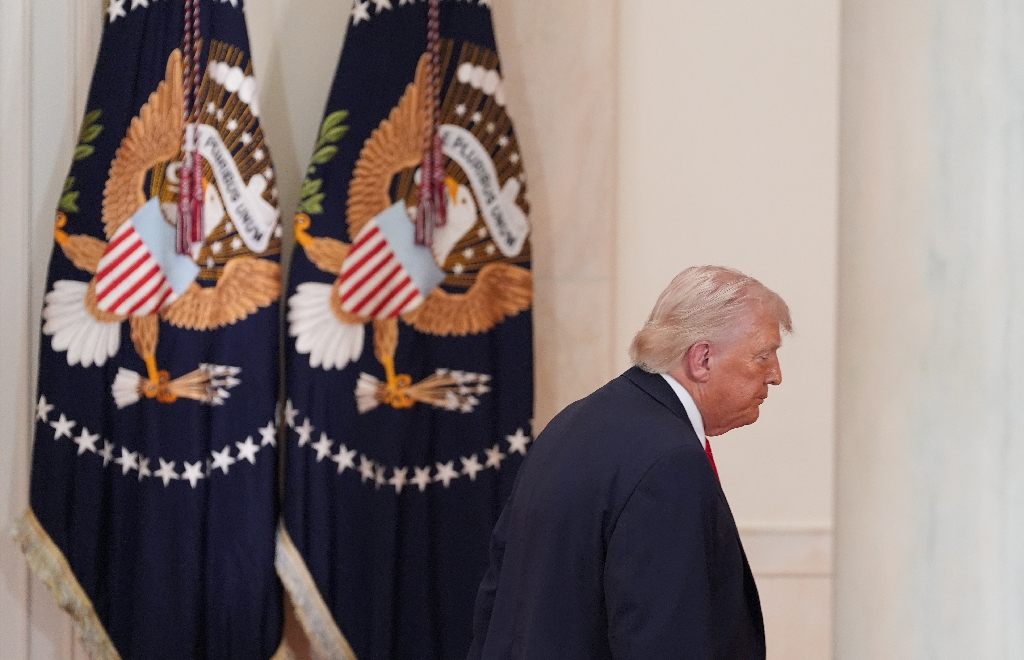
(AFP) – Oil surged and stocks fell on Thursday after Donald Trump threatened further heavy strikes on Iran, and offered no solution to reopening the key Strait of Hormuz. Investors were left unimpressed with the US president’s address to the nation, in which he again urged countries dependent on the waterway for energy supplies to reopen it themselves.
While Trump signalled that the US was “very close” to achieving its military objectives, he vowed “extremely hard” strikes against Iran in the next two to three weeks. Tehran responded by warning the US and Israel to expect “more crushing, broader, and more destructive actions”. The address late Wednesday in the US dampened hopes of de-escalation that had earlier buoyed markets.
International benchmark, Brent North Sea crude, which had fallen below $100 a barrel ahead of Trump’s speech, went on to rally around eight percent to above $109 per barrel. Frankfurt’s stock market shed more than two percent and Paris dropped one percent in midday deals Thursday. London dipped just 0.2 percent, helped by gains of around three percent for the share prices of energy heavyweights BP and Shell.
“Market sentiment has deteriorated overnight after Trump’s much anticipated address delivered little to nothing new on potential timelines or conditions for ending hostilities against Iran,” said Deutsche Bank managing director Jim Reid. “There was no signal of the US seeking an imminent offramp out of the war.” The dollar, seen as a safe haven investment, rose strongly against major rivals.
Asian equities struggled, with Tokyo closing down more than two percent and Hong Kong and Shanghai also lower. Markets have endured huge volatility since the US-Israeli war on Iran was launched on February 28, with Trump frequently U-turning after making policy statements. Markets were volatile amid the “possibility of a growth shock and even stagflation, where low growth and high inflation provide a toxic mix,” said Richard Hunter, head of markets at Interactive Investor.
Trump’s claims that Washington and Tehran were in peace talks have been denied by the Islamic republic, which insists the Strait of Hormuz will remain closed to the country’s “enemies”. Britain was hosting talks featuring some 35 nations Thursday to discuss how to reopen the waterway, through which a fifth of global oil normally travels. World Bank Managing Director Paschal Donohoe said he was fearful about the global economic impact of the crisis. “We are extremely concerned regarding the effect that this will have on inflation, on jobs and on food security,” he told AFP as the Bank partners with the International Monetary Fund and International Energy Agency to coordinate aid responses.
– Key figures at around 1045 GMT –
Brent North Sea Crude: UP 7.8 percent at $109.00 a barrel
West Texas Intermediate: UP 8.3 percent at $108.38 a barrel
London – FTSE 100: DOWN 0.2 percent at 10,341.03 points
Paris – CAC 40: DOWN 1.2 percent at 7,889.14
Frankfurt – DAX: DOWN 2.1 percent at 22,898.67
Tokyo – Nikkei 225: DOWN 2.4 percent at 52,463.27 (close)
Hong Kong – Hang Seng Index: DOWN 0.7 percent at 25,116.53 (close)
Shanghai – Composite: DOWN 0.7 percent at 3,919.29 (close)
New York – Dow: UP 0.5 percent at 46,565.74 (close)
Euro/dollar: DOWN at $1.1519 from $1.1586 on Wednesday
Pound/dollar: DOWN at $1.3189 from $1.3305
Dollar/yen: UP at 159.63 from 158.88 yen
Euro/pound: UP at 87.32 pence from 87.08 pence
© 2024 AFP