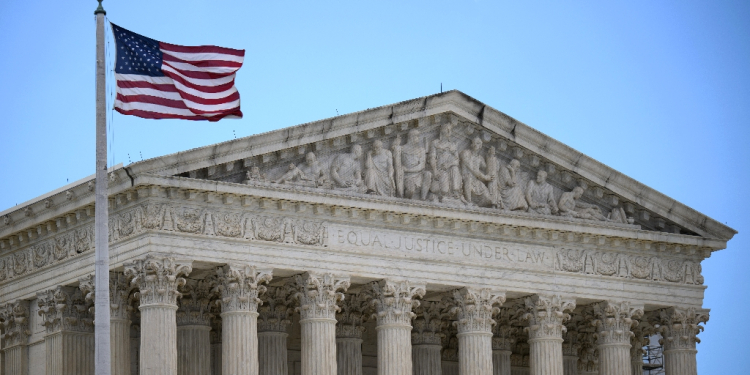
(AFP) – The US Supreme Court on Tuesday examined a former policy of turning away migrants before they crossed the US-Mexico border to present an asylum claim. The policy, known as “metering,” has not been in place since 2021, but President Donald Trump is seeking a ruling validating it as legal in the event it may be reinstated.
The policy allowed federal US agents on the Mexican side of the US-Mexico border to turn away potential asylum seekers before they reached US soil. The Immigration and Nationality Act allows an “alien who is physically present in the United States or who arrives in the United States” to apply for asylum. A divided appeals court ruled in 2024 that this applies to potential asylum seekers at ports of entry “whichever side of the border they are standing on.” The Trump administration is asking the conservative-dominated Supreme Court to reject this interpretation.
The question before the Supreme Court is “whether an alien who is stopped on the Mexican side of the US-Mexico border ‘arrives in the United States.'” Addressing the court on Tuesday, Vivek Suri, an assistant to the solicitor general, said: “You can’t arrive in the United States while you’re still standing in Mexico. That should be the end of this case.” Suri said that although the turnback policy is not currently in place, the administration is seeking a favorable ruling from the Supreme Court in case it wants to use it in the future. “This is an important tool in the government’s toolbox for dealing with border surges when they occur,” he said. “It’s not something the court should leave to future uncertainty.”
Kelsi Corkran, an attorney for Al Otro Lado, an immigration rights group representing asylum seekers, said it was an “unusual scenario” to have “officers standing there (on the Mexican side of the border) and turning people back.” “I think it’s important to remember that from 1917 to 2016 — 99 years — there was not a single example of a turnback,” Corkran said. “People would come through the port. At that point when they were in the port, they would be inspected and processing would happen.”
Justice Ketanji Brown Jackson, one of the three liberals on the nine-member court, said the turnback policy would seem to incentivize illegal border crossing and require “people to break the law in order to obtain it.” Asylum seekers who cross into the United States illegally can have their requests entertained, but those who try to “do everything by the book” are turned away before reaching the border, Jackson said.
Justice Amy Coney Barrett, a conservative, sought some clarity on what it means to “arrive” in the United States. “If it’s not crossing the physical border what is the magic thing, or the dispositive thing, that we’re looking for where we say, ‘Ah, now that person, we can say, arrives in the United States,'” Coney Barrett said.
Trump campaigned for the White House on a promise to expel millions of undocumented migrants and has taken a number of actions since returning to the White House aimed at speeding up deportations and reducing border crossings. The asylum case is one of a number of immigration-related cases the Supreme Court has agreed to hear this year. On April 1, the justices are to hear a challenge to Trump’s bid to end birthright citizenship. They have also agreed to rule on the administration’s bid to strip temporary legal protections against deportation from Haitian and Syrian migrants.
– Chris Lefkow
© 2024 AFP