Washington (AFP) – From fearmongering about a looming “World War III” to false narratives linking a cabal of global elite to a cyberattack, a torrent of online conspiracy theories took off Friday after a major IT crash.
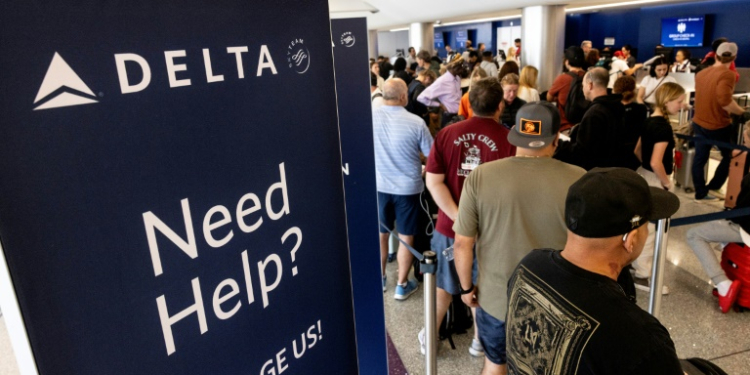
Airlines, banks, TV channels and financial institutions were engulfed in turmoil after the crash, one of the biggest in recent years that was the result of a faulty software update to an antivirus program operating on Microsoft Windows.
The proliferation of internet-breaking conspiracy theories on social media platforms — many of which have removed guardrails that once contained the spread of misinformation — illustrates the new normal of information chaos after a major world event.
The outage gave way to a swirl of evidence-free posts on X, the Elon Musk-owned site formerly known as Twitter, that peddled an apocalyptic narrative: The world was under attack by a nefarious force.
“I read somewhere once that ww3 (World War III) would be mostly a cyber war,” one user wrote on X.
The IT crash also stirred up an unfounded theory that the World Economic Forum — long a magnet for wild falsehoods — had plotted a global cyberattack.
To make that theory appear credible, many posts linked an old WEF video that warned about the possibility of a “cyberattack with Covid-like characteristics.”
The video, available on the WEF’s website, had cautioned that the only way to stop the exponential spread of the cyber threat would be to disconnect millions of vulnerable devices from each other and the internet.
– ‘Sad testament’ – The WEF has long been a target for conspiracy theorists pushing the idea of a shadowy cabal of elites working for private gain under the garb of solving global issues.
Also gaining rapid traction online were conspiratorial posts using the hashtag “cyber polygon,” a reference to a global training event aimed at preparing for potential future attacks.
“The proliferation of conspiracy theories in the wake of major global events such as the outage is a sad testament to the volatile nature of the information ecosystem,” Rafi Mendelsohn, vice president at the disinformation security company Cyabra, told AFP.
“What is unique to events like these is how social media platforms, forums, and messaging apps facilitate the rapid dissemination of content, allowing theories to gain traction quickly and reach a global audience.”
The trend demonstrates the ability of falsehoods to mutate into viral narratives on tech platforms, which have scaled back content moderation and reinstated accounts that are known purveyors of misinformation.
During fast-developing news events, confusion now often reigns on major tech platforms, with users scrambling to obtain accurate information in what appears to be a sea of false or misleading posts that rapidly gain traction.
– ‘Nefarious motives’ – “This poses the larger question of combatting mis- and disinformation,” Michael W. Mosser, executive director of the Global Disinformation Lab at the University of Texas at Austin, told AFP.
“The level of trust that is required to accept information from reputable sources has declined to such an extent that people are more willing to believe wild conspiracies that ‘must be true’ rather than the factual information relayed to them.”
The global outage, which brought myriad aspects of daily life to a standstill and sent US stocks falling, was linked to a bug in an update to an antivirus program for Windows systems from American cybersecurity group CrowdStrike.
Assurances by the Austin-based company’s chief executive, George Kurtz, that CrowdStrike had rolled out a fix and was “actively working” to resolve the crisis did little to stem the spread of online conspiracies.
“Combatting this misinformation with factual rebuttals is difficult, because the issue is so technical,” Mosser said.
“Explaining that the fault was in an improperly configured system file and that a fix is in process may be accurate, but it is not believed by those who are predisposed to see nefarious motives behind failures.”
burs-ac/acb
© 2024 AFP