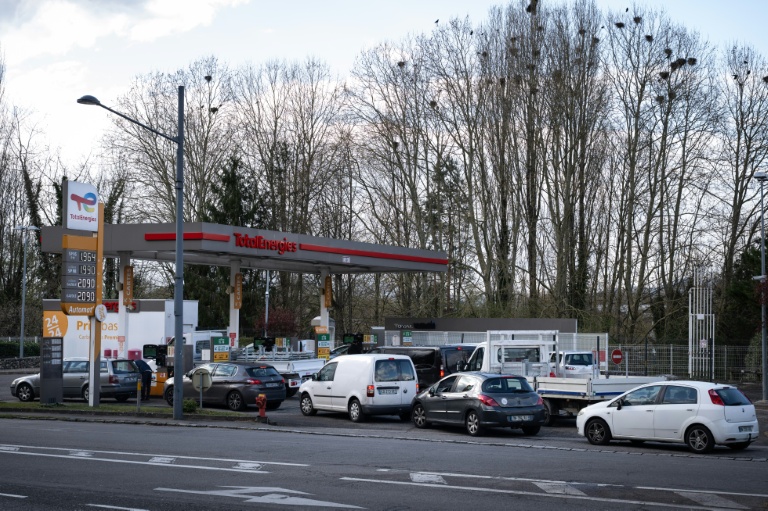
Paris (France) (AFP) – The price of diesel fuel has rocketed by more than 30 percent across Europe since the start of the Middle East war, highlighting the continent’s dependence on imported energy and the lingering prominence of diesel on the car market. The Easter holiday weekend across Europe is expected to see a surge in demand, with queues at petrol stations. Diesel has been worse hit than other fuels, and was already under pressure before the war. Experts say its cost will rise further — with a knock-on effect on inflation — as long as trade through the Strait of Hormuz remains blocked. The per-barrel price of diesel rose above $200 in Europe on Thursday, the highest since March 2022 when Russia’s invasion of Ukraine shook markets.
Diesel is ubiquitous in Europe. While electric cars are making inroads in new sales, diesel is still the most widely used fuel. Trucks, farm tractors, buses, building site machinery, and even shipping depend on it. Diesel accounted for 86 percent of transport fuel sales in Latvia in 2024, 73 percent in France, and 66 percent in Germany, according to FuelsEurope, a trade body which represents the refining industry. The international supply-and-demand balance for diesel “was much tighter than the gasoline balance going into the war and the subsequent market response has been one of strong gasoil (diesel) price escalation while gasoline’s price response has been somewhat muted,” Susan Bell, a commodity markets specialist at Rystad Energy, a consultancy, told AFP.
In Britain, France, and other countries, the price of diesel has risen more than 30 percent since the first US-Israeli air strikes on Iran and resulting choking of the Strait of Hormuz. In France, the price of regular petrol has gone up by just 17 percent, according to government statistics consulted by AFP. The Netherlands has the most expensive diesel in Europe at more than $2.80 a litre, according to research by the RAC, a British motoring organisation. That is about 20 percent more than Italy, the cheapest country surveyed by the RAC.
Diesel was for a long time cheaper than petrol. At the end of the 20th century, governments and car firms encouraged drivers to buy diesel-engine cars. But not enough refineries were built to keep up with demand for the fuel, and in recent years, governments have imposed higher taxes on it. The European Union is now a net exporter of petrol, mainly to the United States and Africa, but an importer of diesel. Russia was Europe’s main source of diesel until Moscow’s all-out invasion of Ukraine in 2022 set off international sanctions. Now EU nations look to India, Turkey, the United States, and Saudi Arabia for supplies. Middle East states provided more than half of Europe’s diesel in 2025 (554,000 barrels a day out of 1.06 million), according to Rystad Energy. About one third of this passed through the Strait Hormuz.
Europe is now struggling to find alternatives. Slovakia last month ordered a 30-day restriction on diesel sales while foreigners have to pay more for the fuel there. Ireland and Spain have temporarily cut the taxes they charge on the fuel. “Refineries are working at full capacity,” said an expert at French energy giant TotalEnergies, which has six refineries across Europe. “Even with maximum adjustment to our settings, the room for manoeuvre remains minimal,” for TotalEnergies, he added.
Bell said that if there is a shortage of regular petrol, then Europe can cut its exports. But that doesn’t work for diesel. “The most efficient and economical solution for Europe would be to source its diesel from Russia,” said Bell. The EU will not be lifting its sanctions anytime soon, however. Postponing refinery maintenance, using strategic reserves, and reducing consumption appear to be the only other ways to partially address the imbalance, she said.
© 2024 AFP