Wednesday, September 16, 2026
MagnifyPost.com
  • Home
  • General News
  • Politics
  • Entertainment
  • Environment
  • Science & Technology
  • Sport
  • Economy
No Result
View All Result
MagnifyPost.com
Home Science & Technology

NASA scan discovers new, ‘once in a century’ Moon crater

by Thomas B.
1 hour ago
in Science & Technology
Reading Time: 3 mins read
A A
0
4
SHARES
8
VIEWS
Share on FacebookShare on XShare on Linkedin

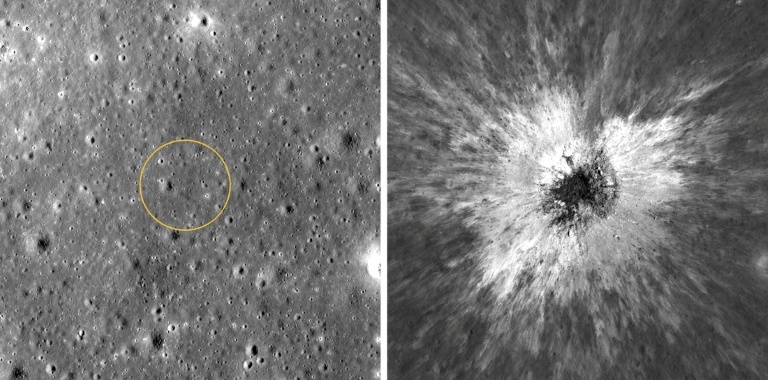
Before the impact (L) and after the creation of a new crater on the Moon's surface, taken by the Lunar Reconnaissance Orbiter Camera. ©AFP

Washington (United States) (AFP) – A researcher at NASA has found a massive, recently-formed crater on the Moon, a rare occurrence that only happens “once in a century or even longer,” according to scientists. The crater, dubbed “McGetchin,” measures 730 feet (222 meters) wide, NASA said in a blog post. It is believed to have been created in the spring of 2024 from a comet or asteroid colliding with the Moon, with researchers describing the object that caused it to be the size of a building three-to-six stories high.

“Scientists estimate that an impact of this magnitude happens on the Moon about once in a century or even longer,” NASA said in the blog post. Although the crater had been there for years, it was not discovered until Robert Wagner, a researcher with NASA’s Lunar Reconnaissance Orbiter (LRO), noticed it in a new scan of the Moon’s surface. The crater appeared as a “large bright spot circled by a dark halo” by the LRO probe, which has been studying the Moon since 2009.

A study published Wednesday in the journal Science Advances determined it was the largest new crater ever discovered in the solar system. While the Moon has numerous craters, many of which are far bigger than McGetchin, researching a crater’s formation in real time can help build understanding of the Moon’s geology. This in turn could better prepare future crewed missions to the Moon, which are currently planned by both the United States and China.

Unlike Earth, the Moon has virtually no atmospheric layer, so space debris does not slow down or burn up before colliding with the surface.

© 2024 AFP
Tags: AstronomyMoonNASA
Share2Tweet1ShareSend
0 0 votes
Article Rating
Subscribe
Notify of
guest
guest
0 Comments
Oldest
Newest Most Voted

Follow us

Recent News

NASA scan discovers new, ‘once in a century’ Moon crater

September 16, 2026

Lula says he will go to UN to tell Trump to ‘stay out’ of Brazil’s elections

September 16, 2026

Trump’s chief of staff says she’s free of cancer

September 16, 2026
MagnifyPost.com

We bring you the top international news & headlines from around the world with live updates on breaking global events.

News

  • Entertainment
  • Environment
  • General News
  • Politics
  • Science & Technology

Pages

  • Home
  • About Us
  • Contact Us
  • Privacy Policy

Network

  • Coolinarco.com
  • CasualSelf.com
  • Fit.CasualSelf.com
  • Sport.CasualSelf.com
  • MachinaSphere.com
  • SportBeep.com
  • EconomyLens.com
  • TodayAiNews.com
  • VideosArena.com
Your Privacy Choices

© 2026 Top World News ~ MagnifyPost.com

No Result
View All Result
  • Home
  • Politics
  • General News
  • Entertainment
  • Environment
  • Science & Technology

© 2023 - Premium news by MagnifyPost.

Coolinarco.com CasualSelf.com

wpDiscuz