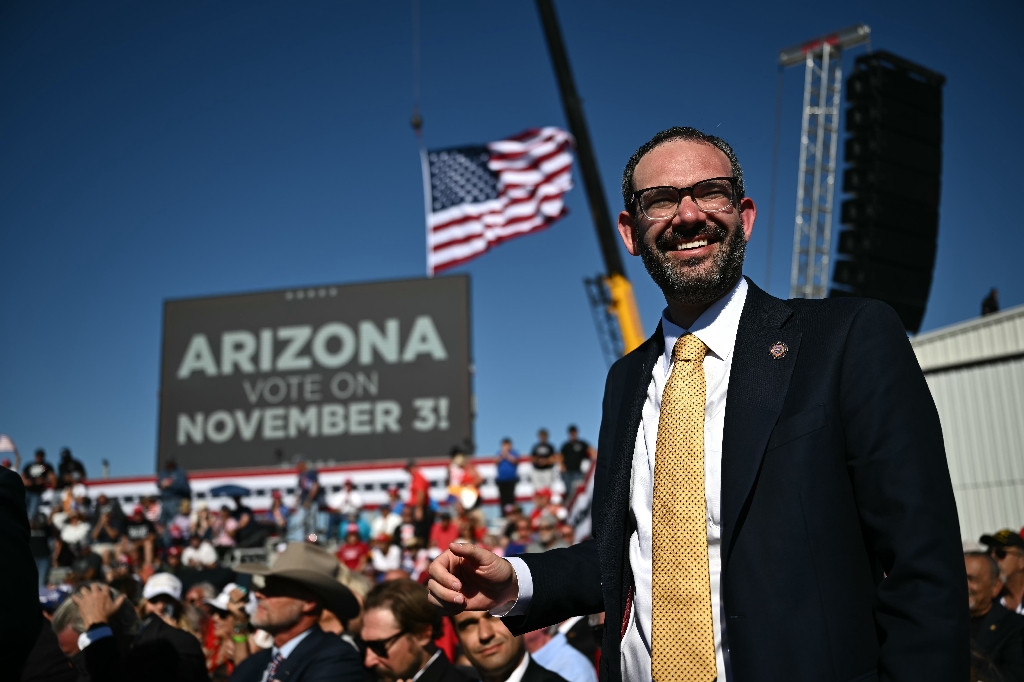
(AFP) – With his impeccable suit, his studious-looking glasses, and his law degree, Alexander Kolodin might appear an ideal candidate to become secretary of state for the US state of Arizona, responsible for managing elections. But Kolodin doesn’t have a great track record in honoring what the electorate voted for. He was part of the legal team that tried to overturn the results of the 2020 US presidential vote. Now opponents worry that if he wins the job in Tuesday’s midterm elections, he could abuse his powers to help Donald Trump subvert American democracy.
“He is an election denier, and he’s got issues with the truth,” Adrian Fontes, the current secretary of state of Arizona, told AFP. “I think he would go so far as to allow President Trump to run for a third term on Arizona’s ballot, which is a violation of the Constitution. I think he would find some tortured legal explanation to make that happen,” said Fontes, a Democrat campaigning for reelection.
Trump lost Arizona in 2020 by around 10,000 votes, a loss he refused to accept. Kolodin was part of a team of lawyers who filed a 300-page lawsuit seeking to overturn the result, alleging widespread voter fraud. They presented no credible evidence, and repeated investigations found no wrongdoing. Kolodin’s lawsuit was deemed frivolous, and he was reprimanded by the state’s bar association, who handed him an 18-month probation and ordered him to attend courses on ethics in law.
For Trump, who was in Arizona this month to support Kolodin and other Make America Great Again (MAGA) candidates, this official sanctioning is less important than his man’s appearance. “Alex, good luck. You look good. Central Casting, actually,” Trump said at a rally in the Arizona city of Bullhead. “You want a secretary of state to look exactly like that, a little bit nerdy, and that’s good.”
Kolodin ignored multiple AFP requests for an interview, but during a debate in August, he rejected accusations that he is an “election denier.” He dismissed the label as “absurd” and “ridiculous,” promising instead to “restore elections that are lawful, secure, transparent, and honest.”
In recent months, Trump and his surrogates have mounted a growing campaign to sow doubt about the probity of US elections, which commentators view as a pre-emptive effort to reject the results of Tuesday’s vote in which the Republican Party is expected to fare badly. The administration has already unsuccessfully attempted to interfere with election procedures in several states, alleging that non-citizens were included on voter rolls. This week the president offered a $1 million reward to any American who reports proven instances of fraud. He gave no details about how the reward would be administered or funded. Studies have repeatedly shown that instances of fraud in US elections are rare and never affect the outcome.
Against this backdrop, Kolodin’s track record is a source of concern for former conservative election officials in Arizona. “I just worry about him telling lies about elections and destroying the confidence that voters have in their election system,” says Ken Bennett, a Republican who was secretary of state for six years. The 67-year-old is particularly alarmed by a referendum Kolodin is pushing that would require voters to prove their identity when voting by mail. Trump himself has railed against mail-in voting for years despite doing it himself.
In Arizona, the vast majority of voters must already present identification when registering to vote. Their signed ballot paper is checked against the verified register by election workers. The proposition backed by Kolodin does not specify how mail-in voters should prove their identity but leaves the Republican-controlled legislature to devise the system at a later date. “Arizona voters are being asked to vote on something, but you’re not telling them what it is exactly that they’re agreeing to,” said Bill Gates, another former Republican elected official who is now an election administration expert at Arizona State University. “That’s a concern.”
For Gates and for Bennett, the worry is that unnecessary restrictions on voting by mail would effectively disenfranchise people. That’s a worry that Fontes shares, saying it could affect both parties. “A lot of Republicans really love that way of voting, and Mr. Kolodin wants to kill it just because of conspiracy theories,” he said. “It’s crazy.”
rfo/hg/msp – Romain FONSEGRIVES
© 2024 AFP