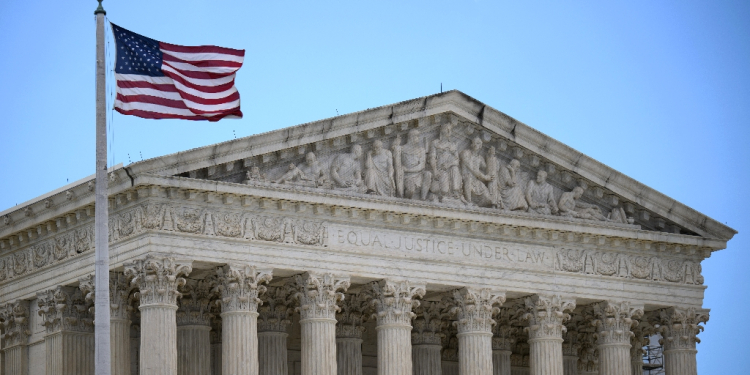
(AFP) – President Donald Trump will watch the US Supreme Court hear a landmark case Wednesday weighing the constitutionality of his contentious bid to end birthright citizenship — an extraordinary and possibly unprecedented move for the nation’s highest office. Trump signed an executive order on his return to the White House decreeing that children born to parents in the United States illegally or on temporary visas would not automatically become US citizens. Lower courts blocked the move as unconstitutional, ruling that under the Citizenship Clause of the 14th Amendment nearly everyone born on US soil is an American citizen.
“All persons born or naturalized in the United States, and subject to the jurisdiction thereof, are citizens of the United States,” the amendment states. It does not apply to persons who are not subject to US jurisdiction — foreign diplomats, for example, and sovereign Native American tribes.
“I’m going,” Trump told reporters Tuesday when asked about the Supreme Court hearing. He had attended the investiture ceremony of his first Supreme Court justice nominee, Neil Gorsuch, in 2017, months into Trump’s first term. But it would be an exceptional milestone for a sitting president to be present for oral arguments in a case their administration is actively arguing.
The Trump administration argues that the 14th Amendment, passed in the wake of the 1861-1865 Civil War, addresses the rights to citizenship of former slaves and not the children of undocumented migrants or temporary visitors. Trump’s executive order is premised on the notion that anyone in the United States illegally, or on a visa, is not “subject to the jurisdiction” of the country and therefore excluded from automatic citizenship.
The Supreme Court rejected such a narrow definition in an 1898 case involving a man named Wong Kim Ark, who was born in San Francisco in 1873 to parents who had come to the United States from China. After a visit to China, Wong Kim Ark was denied reentry into the United States in 1895 under the Chinese Exclusion Acts. The Supreme Court ruled, however, that he was a US citizen by virtue of being born in the United States.
– ‘History and tradition’ –
Steven Schwinn, a law professor at the University of Illinois Chicago, said the court is likely to reject the challenge to birthright citizenship. “This is a court that has looked to history and tradition as a significant guide in understanding the Constitution,” Schwinn told AFP. “And it would be a little surprising if, after 150 years, we suddenly discovered we were applying the Citizenship Clause all wrong.” Conservatives have a 6-3 supermajority on the high court and three of the justices were appointed by Trump.
Trump’s solicitor general, John Sauer, said that in order to be eligible for citizenship “a person must be both born ‘in the United States’ and ‘subject to the jurisdiction thereof.'” “Children of temporarily present aliens or illegal aliens are not ‘subject to’ the United States’ ‘jurisdiction,'” Sauer said in a brief with the court. “A person is subject to the United States’ ‘jurisdiction’ only if he owes sufficient allegiance to, and may claim protection from, the United States.” Automatic citizenship for children of undocumented migrants is a “powerful incentive for illegal migration,” Sauer said, claiming it encourages “birth tourists.”
– ‘Dumb judges and justices’ –
If the Supreme Court does reject ending birthright citizenship, it would be the second major loss for Trump this term — the justices struck down most of his global tariffs in February. Trump reacted furiously to that ruling and called birthright citizenship one of the “great scams of our time” on Tuesday, a day after he took to Truth Social to denounce “dumb judges and justices.”
The American Civil Liberties Union, which is defending birthright citizenship before the court, said the Trump administration “is asking for nothing less than a remaking of our Nation’s constitutional foundations.” “The government’s baseless arguments — if accepted — would cast a shadow over the citizenship of millions upon millions of Americans, going back generations.” A decision in the case is expected by late June or early July.
– Chris Lefkow
© 2024 AFP