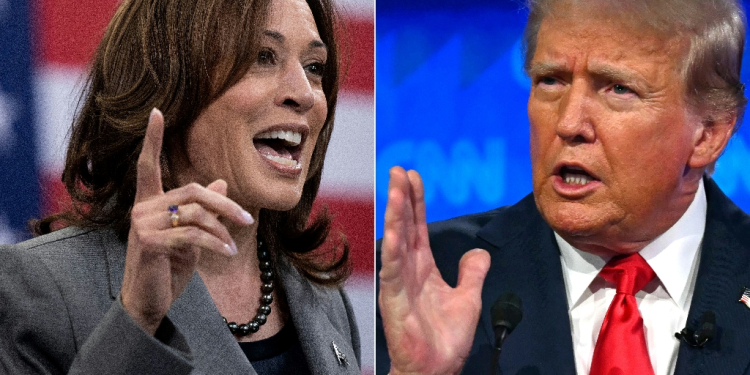
(AFP) – Donald Trump and Kamala Harris agree on very little, but the two presidential rivals have found common ground in calling for the elimination of taxes on tips — a populist move that many criticize as economically irresponsible. Trump was the first to announce his plan earlier this summer, while Harris surprised supporters with a similar policy this past week.
It’s no coincidence that both candidates made their pledges in Nevada – a crucial battleground state which has the highest relative number of waiting staff in the United States, according to the US Labor Department. Tipping culture in the United States is fundamentally different from most other countries, as customers are encouraged to tip generously on everything from take-out coffee to cocktails. A tip ranging between 15 and 20 percent of the price is considered normal at most restaurants.
It is still legal in some US states for employers to pay tipped workers as little as $2.13 per hour — well below the federal minimum wage of $7.25 — so long as their tips make up the difference. With such a significant chunk of service-sector wages coming from tips, it’s not surprising that the policy has such broad appeal — even if many economists and think tanks do not like it.
“There’s no particular reason that, in general, people in the service industry should pay lower taxes than somebody on the factory line, or somebody that’s providing nursing care,” Marc Goldwein, the senior vice president of the nonpartisan Committee for a Responsible Federal Budget (CRFB), told AFP. “This creates an equity issue where two people doing similar work that the market has deemed is worth the same amount of money pay different levels of taxes,” he said. “That doesn’t make any sense.”
– Who stands to benefit? –
There are around four million tipped workers in the United States, or roughly 2.5 percent of all employment, according to a recent estimate from Yale University’s Budget Lab — a figure that includes waiting staff, bartenders, and hairdressers. Tipped workers tend to have a lower weekly wage than average, and the Budget Lab estimates that around 37 percent of them did not pay any federal income tax at all in 2022. However, once tax credits are taken into account, the situation gets more complicated, according to Goldwein from CRFB.
That’s because the United States has a number of tax credits that are “refundable” — meaning they can be reclaimed by eligible taxpayers, even if they are not earning enough money to pay income taxes. “In other words, just because you pay no taxes doesn’t mean you won’t benefit from a plan to exempt taxes from tips,” he said.
– Fundamental fairness –
One of the major criticisms of the policy is that it is just fundamentally unfair, according to Goldwein from CRFB. “I think it’s almost universally understood that similar types of income should be treated similarly,” he said, adding that there was no reason why a waitress and a McDonald’s worker on the same wage should be paying different taxes. Eliminating taxes on tips would also have the effect of pushing up the deficit if the revenue is not collected elsewhere. The CRFB estimated that Harris’s more modest plans would add between $100-$200 billion to the deficit, while Trump’s proposals could add between $150-$250 billion.
The policy could also push more workers to reclassify their incomes, which would increase the portion of overall compensation they receive from tips — and convince more institutions to adopt tipped wages. “If the guardrails aren’t strong, you’re going to see it in brand new industries that never had tipping as a major part,” Goldwein from CRFB said. “But even if there are really good rules to prevent that, when you tax something less, you get more of it.”
“It’s a poorly targeted change, with the potential for unintended consequences for both consumers and the federal budget,” Alex Muresianu, a senior policy analyst at the Tax Foundation think tank, wrote in a blog post last month before Harris announced her plans. It could mean “more service industries adopting the restaurant industry approach of a list price up front and an expected voluntary tip at the end of the transaction,” he said.
– Daniel AVIS
© 2024 AFP