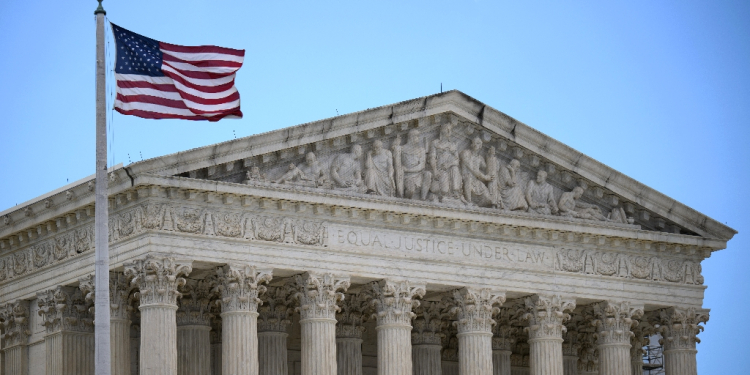
(AFP) – The US Supreme Court agreed on Friday to weigh in on the constitutionality of President Donald Trump’s bid to end birthright citizenship. The conservative-dominated court did not set a date for oral arguments in the blockbuster case, but it is likely to be early next year, with a ruling in June. Several lower courts have blocked as unconstitutional Trump’s attempt to put restrictions on the law that states that anyone born on US soil is automatically an American citizen.
Trump signed an executive order on his first day in office in January decreeing that children born to parents in the United States illegally or on temporary visas would not automatically become US citizens. Lower courts have ruled the order to be a violation of the 14th Amendment, which states: “All persons born or naturalized in the United States, and subject to the jurisdiction thereof, are citizens of the United States and of the State wherein they reside.” Trump’s executive order was premised on the idea that anyone in the United States illegally or on a visa was not “subject to the jurisdiction” of the country, and therefore excluded from this category. The Supreme Court rejected such a narrow definition in a landmark 1898 case.
The Trump administration has also argued that the 14th Amendment, passed in the wake of the Civil War, addresses the rights of former slaves and not the children of undocumented migrants or temporary US visitors. In a brief with the court, Trump’s solicitor general, John Sauer, argued that “the erroneous extension of birthright citizenship to the children of illegal aliens has caused substantial harm to the United States.” “Most obviously, it has impaired the United States’ territorial integrity by creating a strong incentive for illegal immigration,” Sauer said.
– ‘Blatantly unconstitutional’ – Trump’s executive order had been due to come into effect on February 19, but it was halted after federal judges ruled against the administration in multiple lawsuits. District Judge John Coughenour, who heard the case in Washington state, described the president’s executive order as “blatantly unconstitutional.” “I’ve been on the bench for over four decades; I can’t remember another case where the question presented is as clear as this one is,” said Coughenour, who was appointed by a Republican president, Ronald Reagan.
Conservatives hold a 6-3 majority on the Supreme Court, and three of the justices were appointed by Trump. Cecillia Wang, national legal director of the American Civil Liberties Union, which has spearheaded the legal challenges to the attempt to end birthright citizenship, said she is hopeful the top court will “strike down this harmful order once and for all.” “Federal courts around the country have consistently rejected President Trump’s attempts to strip away this core constitutional protection,” Wang said. “Depriving any US-born child of their citizenship would be devastating and profoundly cruel,” she said. “The president’s action goes against a core American right that has been a part of our Constitution for over 150 years.”
– Chris Lefkow
© 2024 AFP